Artificial intelligence is becoming one of the most discussed developments in healthcare. A recent peer-reviewed systematic review published in BMC Health Services Research gives useful insight into how healthcare professionals view AI and what may influence its adoption.
A broad look at professional attitudes
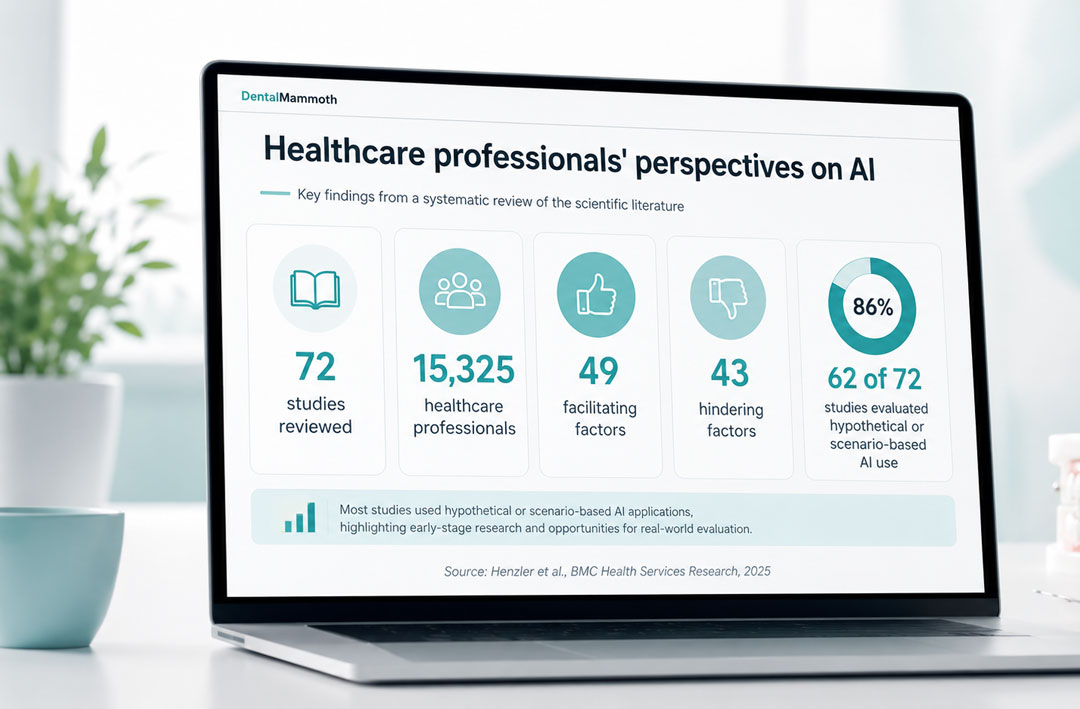
The review analysed 72 studies on healthcare professionals’ perspectives on AI. The review covered 15,325 healthcare professionals from several fields and included studies across different clinical areas, including radiology, primary care, oncology, and orthodontics. The review covered studies from several regions, including Europe, Asia, America, Africa, Australia, and multi-country research.
Optimism is growing — but adoption is complex
The authors found that healthcare professionals generally have a positive view of AI and expect it to bring benefits to health services. However, the review also shows that adoption is not only a technical question. It depends on many human and organisational factors, including knowledge, training, trust, workflow fit, and a clear understanding of how AI should be used.
More than just new software
One of the most striking findings is the number of factors involved. The review identified 49 facilitating factors and 43 hindering factors across different levels of healthcare organisations and professional practice. In other words, successful AI adoption depends on much more than simply introducing new software.
Education is becoming a key factor
Education appears as an important theme. The review notes that greater familiarity with AI, opportunities to test AI applications, education and training programmes, and scientific networks can help professionals understand and evaluate AI tools more confidently.
Lack of knowledge remains a barrier
At the same time, limited understanding of AI, lack of suitable education programmes, and time constraints may hinder adoption among healthcare professionals. This suggests that enthusiasm alone is not enough. Professionals also need time, training, and clear information to build confidence.
Real-world experience is still developing
Another important point is that many studies still focus on hypothetical or scenario-based use of AI. According to the review, 62 of the 72 included studies evaluated hypothetical deployment or scenario-based implementation rather than fully established real-world use. This suggests that AI in healthcare is advancing quickly, but practical experience and implementation research are still developing.
Reference
Henzler, D., Schmidt, S., Koçar, A. et al. Healthcare professionals’ perspectives on artificial intelligence in patient care: a systematic review of hindering and facilitating factors on different levels. BMC Health Services Research 25, 633 (2025).
What this means for dentistry
For dentistry, the message is highly relevant. One of the most visible areas of AI development in dentistry has been radiology, where AI is often discussed in relation to image analysis, pattern recognition, and support for interpreting dental imaging.
But dentistry is not only imaging.
A large part of dental work, education, and professional development depends on structured knowledge: anatomy, pathology, pharmacology, materials, procedures, terminology, treatment concepts, patient communication, and continuous learning. This is where large language models and AI-supported knowledge systems introduce a broader layer of opportunity.
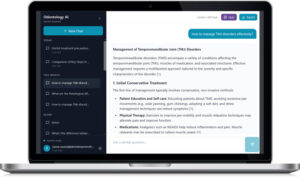
Unlike tools focused mainly on one task or one data type, language-based AI can help users explore complex topics across several levels of dental knowledge. It can support learning by connecting concepts, explaining terminology, summarising scientific information, comparing procedures, and helping professionals or students navigate large volumes of educational content.
This makes the discussion about AI adoption in healthcare especially relevant for dentistry. The question is not only whether AI can make individual tasks faster. The bigger question is whether dental professionals, educators, and students can understand, trust, and use AI-supported information in a meaningful way.
As healthcare continues to explore AI, the discussion is moving from excitement toward practical adoption: quality of information, transparency, usability, professional education, and confidence in the tools being used.